


A modern laboratory for future biomass boiler operators was inaugurated at vocational school no.3 in Chisinau
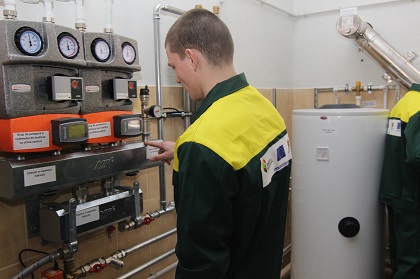
A modern laboratory for the students of the new educational course „Operators of Biomass Boilers” was inaugurated at the vocational school no.3 in Chisinau today. The equipment was procured with the financial support of the Energy and Biomass Project, funded by the European Union and implemented by the United Nations Development Programme.
In 2015-2016 academic year three vocational schools in Moldova have included new biomass energy related courses in their programs, thereby responding to the demand for professionals in the energy sector. The change was possible due to the Partnership Memorandum signed by and between the Minister of Education and the United Nations Development Programme last autumn.
„Vocational Education is currently going through an ample process of modernization and, taking into consideration the impact of this type of education on the labor market, the Ministry of Education is paying considerable attention to this reform. The curriculum has to be updated to correspond to the market needs and even anticipate changes on the market so that the employers are able to find qualified personnel and the future professionals benefit from decent jobs. Our goal is to train highly qualified workers so they can contribute to a competitive economy”, Cristina Boaghe, Deputy Minister of Education, says.
The vocational school no.3 in Chisinau is the first Moldovan education institution to train future operators of biomass boilers. In 2017 over 20 students will be the first full-fledged graduates ready to become “operators of biomass boilers”.
„The biomass market is a wonderful opportunity for the Republic of Moldova to benefit of energy from local origin. Nevertheless, in order for biomass to reach its full potential in the country, it is of key importance that this energy is properly used and that boiler operators are well trained to make the best use of biomass. I therefore highly welcome today the opening of this modern laboratory for future biomass boiler operators at vocational school no.3”, Wicher Slagter, Chargé d’Affaires, EU Delegation to the Republic of Moldova, tells.
The new educational modules – „Energy plants – a renewable energy source” for future foresters and „Biomass heating plants” for future operators in boiler rooms, were included as an absolut first in the academic programs of three vocational schools in Moldova: school in Cuhurestii de Sus village, Floresti rayon; the school in Orhei and the school no.3 in Chisinau.
„The United Nations Development Programme and the European Union support the Government of Moldova in its effort to increase energy security by using its renewable energy potential. Together, in less than 5 years, we managed to achieve a 13% share of renewable energy in the country’s energy balance. This is an outstanding achievement that besides reducing Moldova’s dependence on external energy sources, also implies local economic development and new businesses and jobs. Moreover, the money for the consumed energy remains in the country”, Narine Sahakyan, UNDP Moldova Deputy Resident Representative, said.
Besides theoretical knowledge, students have direct access to the technology they study. The vocational school no. 3 has a laboratory connected to the biomass heating system, equipped with real-time operating biomass boilers of different technologies. Finally, energy willow and acacia are expected to be planted around the vocational schools in the Cuhurestii de Sus village, Floresti rayon and in Orhei in the upcoming weeks.
“The renewable energy sector is developing at a rapid pace. Significant investments have been made in Moldova to spur the launch of a new industry – biomass energy. Along with the biomass energy user sector there is the developing private sector – that is the biggest promotor of biomass producing and burning technologies. In the same time, the growing demand for solid biomass require highly skilled professionals. We expect that other vocational education institutions, as well as higher education institutions, will also introduce such courses in their academic programs”, Mihail Stratan, Director of the Energy Efficiency Agency, claims.
So far over 160 public institutions all over the country have been connected to biomass heating systems with the support of the EU Energy and Biomass Project. About 1,000 families have installed biomass boilers using the grants provided by the project and over 30 Moldovan companies assemble or produce biomass boilers for Moldovan users.
Energy and Biomass Project, second phase, is a three-year EUR 9.41 million project granted by the European Union and implemented by the United Nations Development Programme during 2015-2017.